Spades
Bid together. Play your hand. Back your partner.
Local results · 0 matches finished · 0% won · Best score —
Hand details & score
More card games
What is Spades?
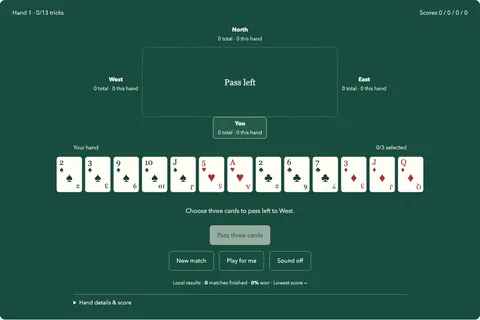
Spades is a partnership card game in which you predict how many tricks you can take, then work with your partner to reach that target. Here you sit at the bottom of the table, North is your computer partner, and West and East play against you. All four seats receive thirteen cards from a shuffled deck. There are no jokers. Aces are high, and the spade suit is always trump.
A trick is one card played by each person. Usually the highest card of the suit led wins, but any spade beats a card from another suit. The winner leads the next trick. You cannot simply play trump whenever you want: if you have a card in the suit led, you must follow suit. That restriction is what makes short suits, long suits, and the timing of high cards matter.
This table uses a fixed ruleset with Nil bids, bags, and a target of 500 points. There are no live opponents, accounts, stakes, or purchases. You can take your time over a decision; the game does not impose a turn countdown. The deal is random, so a difficult hand is part of the game rather than something you need to unlock your way past.
How to play Spades
Make your first bid
Look through your hand and estimate the tricks you can win. Choose a number in the bid selector and press Bid. A bid of zero is Nil: you are promising to take no tricks yourself. Your partner makes a separate bid. The team’s ordinary contract is the sum of its nonzero bids, so a bid of three beside a partner’s four asks your team to win at least seven tricks.
High spades are useful, but do not count every high card as a certain winner. An ace in another suit can lose to a trump if an opponent runs out of that suit. A small spade may eventually win if you have enough of them to outlast the other players. Nil is attractive because of its bonus, but a lone high card or a long spade holding can make avoiding every trick very difficult.
Play a card
On a phone, tap a legal card when it is your turn. On a computer, click it or drag it into the middle of the table. For keyboard play, use Tab to reach an enabled control and Enter or Space to activate it. Unavailable cards are disabled. The status message explains whose turn it is and what action comes next.
You normally cannot lead a spade until a spade has been played on an earlier trick. This is called breaking spades. If your remaining cards are all spades, you may lead one anyway. Once a trick is complete, the table briefly keeps the cards visible before collecting them. Play for me makes one legal decision for your seat; it does not turn on an automatic match. It can help when you are learning what the controls allow.
Follow the team score
A successful contract earns ten points for every trick bid, plus one point for each ordinary overtrick. Bid seven and take eight qualifying tricks, for example, and your contract scores 71 points. Miss the contract and you lose ten points per trick bid. Nil scores a separate 100 points if that player takes no tricks, or loses 100 if they take even one.
Overtricks also accumulate as bags. Every ten bags cost the team 100 points, with leftovers carried forward. Tricks taken by a failed Nil bidder count toward bags but do not help the partner meet the contract and do not earn extra trick points. That detail makes a failed Nil more awkward than simply adding another player’s tricks to the team total.
After each hand, continue until a team reaches at least 500. If both reach the target, the higher score wins; an exact tie means another hand. Negative scores do not end the match early. The Spades rules explain the scoring with more examples.
Spades tips
Help the contract before chasing extras
Watch your partner’s bid and tricks taken as well as your own. If your partner is already winning a trick, spending a higher card may give the other team an easier win later. Once your contract is secure, additional tricks can be a liability because bags carry between hands. You still have to follow suit, so avoiding bags requires planning before you run out of choices.
Treat Nil as a team problem
A partner bidding Nil needs protection. When you can safely win a trick above their card, doing so may protect the bonus. When you are the Nil bidder, look for chances to discard dangerous high cards while another player is clearly winning. The Spades Nil and bags guide covers the tradeoff between a tempting bonus and the longer match score.
Remember what has been played
Notice when someone cannot follow a suit and which high spades have already appeared. Those public clues can improve your next choice without knowing anyone else’s hand. The computer players use their own cards and public information; their strategies do not receive your hidden hand. They make basic tactical choices, but they are not promised to play perfectly.
Your current match, sound setting, and local results are saved in this browser when storage is available. Refreshing resumes that position. A confirmed restart counts as an abandoned match and a loss, so use it when you actually want a fresh deal. For another approach to bidding and partnership play, read the Spades strategy guide.
Spades FAQ
What does Nil mean?
Nil is a bid to take no tricks. It scores 100 points if successful and costs 100 if you take any trick.
When can I lead spades?
After a spade has been played, or when your hand contains only spades.
How do bags work?
Extra tricks accumulate as bags. Every ten bags cost your team 100 points; leftover bags carry over.
Can I play Spades on my phone?
Yes. The table works in a phone browser with tap controls and in a desktop browser with mouse or keyboard controls. You can keep your phone upright; no separate app is needed.
Will my game survive a refresh?
Yes, when local storage is available in this browser. The current game, sound setting, and results are saved on this device. Clearing site data removes them, and they do not sync to other browsers or devices. A notice appears if saving is unavailable.
Keep the rules handy
More on Spades: