How to Play Spades: Rules, Bidding & Scoring
Updated
Spades is a trick-taking game for four players in two partnerships. You bid how many tricks you expect to take, and then try to take exactly that many, or a few more. Play Spades at our table, or read on for the rules from start to finish.
The goal
You and North are partners, against West and East. Partners sit across from each other. Your team scores points for tricks it bids and takes. The first team to reach 500 points wins the game.
The deck and the deal
Spades uses a standard 52-card deck. There are no jokers. Cards rank from Ace (high) down to 2 in every suit. Each player gets 13 cards, dealt clockwise.
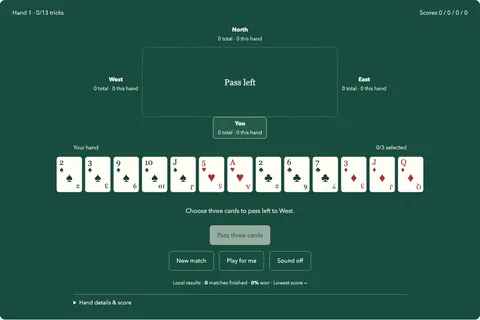
The seats go clockwise: you, West, North, East. On the first hand East deals, so you bid first. After that, the deal passes one seat to the left each hand.
Spades are always trump. A trump beats any card of another suit.
Bidding
Starting to the dealer’s left, each player bids once, from 0 to 13. The bid is the number of tricks you think you will take yourself.
Your team’s contract is your bid plus your partner’s. If you bid 4 and North bids 3, the team needs 7 tricks.
A bid of 0 is Nil. A Nil bidder tries to take no tricks at all. Nil is scored separately from the team contract, and we explain it below and in Spades Nil and bags.
There is no minimum bid and no limit on how much your team can bid in total.
Playing a trick
The player to the dealer’s left leads the first card. In later tricks, the winner of the last trick leads.
- Follow suit. If you hold a card of the suit that was led, you must play one.
- No card of that suit? You may play any card, including a spade.
- Highest wins. The highest spade in the trick wins. If no spade was played, the highest card of the suit that was led wins.
- Leading spades. You cannot lead a spade until spades have been broken, which means a spade has been played in an earlier trick (usually because someone could not follow suit). The exception is a hand with nothing but spades.
The winner collects the four cards as one trick and leads the next. Thirteen tricks make a hand.
Scoring a hand
Each team scores for its contract, then for extra tricks, then for bag penalties.
Making the contract. If your team takes at least as many tricks as it bid, it scores 10 points for each bid trick. A 7-trick contract is worth 70.
Extra tricks. Every trick over your bid is worth 1 point and is also a bag. Bags are tracked from hand to hand.
Missing the contract. If your team takes fewer tricks than it bid, it loses 10 points for each trick it bid. Missing a 7-trick contract costs 70. You do not get anything for the tricks you did take.
Bag penalty. Every time your team’s bags reach ten, it loses 100 points and the bag count drops by ten. Leftover bags carry over to the next hand.
Nil. A Nil bidder who takes no tricks earns 100 points for the team. A Nil bidder who takes any trick costs the team 100. The partner’s contract is scored on its own. If your Nil fails, the tricks you took do not help your partner reach the contract. They count only as bags, and they add no extra points.
How the game ends
After each hand, the totals are checked. When one team has 500 or more and leads, it wins. If both teams are at 500 or more and tied exactly, you play another hand. A team can drop below zero and keep playing, and there is no early loss for a negative score.
The version we use
- Fixed partners: you and North against West and East.
- Standard Nil, worth 100 either way. There is no Blind Nil.
- The ten-bag penalty is 100 points, and extra tricks are worth 1 point each.
- A missed contract is a flat 10 points per bid trick.
- No bonus for bidding all 13 tricks or for a combined bid of ten or more.
- Spades must be broken before they can be led, unless you hold only spades.
These choices follow the basic four-player partnership game described by Pagat. Some rule sets score Nil differently, play to 250 or 300, or use Blind Nil and other special bids. We use the version above so you can learn it once and play it the same way every time.
A worked example
Suppose you hold: ♠ A K 7 3; ♥ A Q 5; ♦ K 9 4; ♣ 8 6 3. The A♠, K♠, A♥ and K♦ look like four good tricks, so you bid 4. West bids 2, North bids 3, and East bids 3.
Your team’s contract is 7 tricks (4 + 3). West and East have 5.
The hand is played out. At the end, you and North took 9 tricks together. That is two more than your contract. You score 70 for the contract, plus 2 for the extra tricks, which is 72. You also add 2 bags.
West and East took 4 tricks. They bid 5, so they missed it. They lose 50 points.
Now a trickier hand. You bid 4 and North bids Nil. Your team’s contract is 4. You take 4 tricks, and North is forced to take one. The contract is made, so you score 40. North’s Nil failed, which costs 100, and North’s one trick is a bag. The hand totals −60 for your team, with 1 bag.
Finally, bags. If your team has 8 bags and gets 3 more, that is 11. You lose 100 points and keep 1 bag.
When you are ready to improve, read the Spades strategy guide.
A few good questions
What does Nil mean?
Nil is a bid to take no tricks. It scores 100 points if successful and costs 100 if you take any trick.
When can I lead spades?
After a spade has been played, or when your hand contains only spades.
How do bags work?
Extra tricks accumulate as bags. Every ten bags cost your team 100 points; leftover bags carry over.