Spades strategy for better bids and fewer bags
Updated
Most Spades games are decided before the first card is played. A team that bids well scores steadily, and a team that bids badly loses points to misses and bags. Here is how to bid, then how to play the hand. The Spades rules cover the basics if you need them.
Count your bid honestly
Start with the cards that almost always win a trick:
- Every Ace outside spades.
- The A♠ and K♠. A K♠ is nearly as good as an Ace once the A♠ has been played, and in a short suit it may be forced out first, so judge it by how many spades you hold.
- A King with at least one small card in its suit, such as K♦ 9♦ 4♦. A King by itself can be caught by the Ace.
- Extra spades. Once the high spades are gone, long spades can win tricks too.
Then think about short suits. A suit where you hold only one or two small cards lets you play a spade on the first or second round, and that trump can win a trick. Voids and singletons add to your count, but only if you have enough spades to use them.
Suppose you hold: ♠ A K 7 3; ♥ A Q 5; ♦ K 9 4; ♣ 8 6 3. You have the A♠ and K♠, the A♥, and the K♦ with some company. Four tricks is a fair bid. The Q♥ and the low clubs are not worth counting.
When you are unsure, shade your bid down by one rather than up. A missed contract costs 10 points for every trick you bid, and you lose it all even if you came close. An extra trick is not free either. It scores 1 point, but it is also a bag, and every ten bags cost 100. So an unneeded overtrick is worth roughly nothing, and a missed contract is a disaster. Aim to land on your bid exactly.
Think of the table as a team
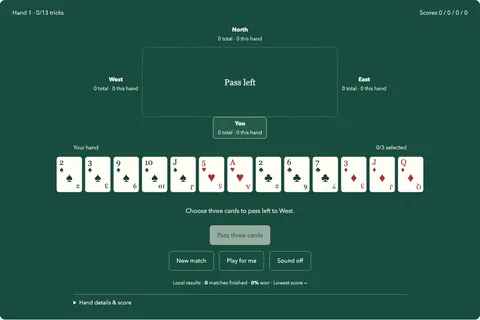
Your bid and your partner’s add up to one contract. If you bid 4 and North bid 3, you need 7 tricks together. After the bidding you also know what West and East need.
If they bid 8 and you bid only 4, they need 8 of the 13 tricks. You and North only need to take 6 tricks between you to set them. When a contract looks heavy, play to stop their tricks and save your high cards for that.
Playing with your partner
Do not overtake your partner. If North plays the A♦ and wins, you do not need to put the K♦ over it. Play your lowest card. The trick is already yours, and your King may win another one later.
Help your partner’s bid. After the bidding you know roughly how strong North is. If North bid 4, they probably hold the top spades or several Aces. Try not to take tricks North was counting on, and lead suits where North is likely to be strong.
Cut when it matters. If you are void in a suit and the opponents lead it, you can play a spade and win the trick. That is a real winner, but only use it when the trick is worth taking. If North is already winning, play a low card from another suit instead.
Spades as a weapon
Spades are the only suit that can beat the other three, so the order they come out matters.
- If you hold A♠ and K♠ and a few more spades, you can lead them to pull out the opponents’ spades. After that, your smaller spades can win tricks too.
- If you hold only one or two low spades, keep them for later. A small spade can cut a trick when another player has run out of a suit, which is worth more than leading it early.
- Do not lead a low spade just to get rid of it. It gives the opponents a free trick.
Keep track of spades
There are 13 spades in the deck. Count them as they fall. If you hold five spades and four others have been played, four are still in the other hands. If the A♠ and K♠ are already gone, your Q♠ is now the top spade, and you can lead it knowing it will win.
Watch your bags
Every trick over your bid is a bag, and ten bags cost 100 points. Two teams that bid well and keep a low bag count will pull ahead of two teams that take loose overtricks.
Near the end of a hand, if you already have the tricks you bid, think about giving up a trick on purpose rather than winning with a spare high card. Your partner can do the same. There is more on this in our guide to Spades Nil and bags.
A small checklist
- Count Aces, protected Kings, and spades before you bid.
- Do not overtake a winning partner.
- Remember how many spades have gone.
- Know your team’s bag count before you take the last few tricks.
Ready to put it to work? Play Spades.
A few good questions
How many tricks should I bid with a typical hand?
Count the Aces, the Kings that are protected by another card in their suit, and the spades that are likely to win. A hand with two or three of those is usually a bid of 2 or 3.
Should I overtake my partner's winning card?
Usually not. If your partner is already winning the trick, play your lowest legal card and save your high cards for tricks you need.